|
Home / / / / / / Electrical Engineering Baskin School of Engineering UC Santa Cruz
© 2013 H. Schmidt. All rights reserved. Contact
 |
 |
 |
 |
 |
 |
 |
 |
 |
 |


Involvement of undergraduate students at various levels and from different departments is an integral part of the Applied Optics group. Undergraduates typically work in the group for a year of longer on independent projects, but in close collaboration with a graduate student or postdoc. The projects are usually components of our larger research projects. Occasionally, the projects are the senior thesis project of the student. Students are usually supported by REU grants from the National Science Foundation or fellowships. Applied Optics students have consistently done excellent research work and have been recognized by undergraduate research awards at UCSC. We are always looking for academically outstanding and highly motivated undergraduates to get research experience in our lab. Below is an overview of projects that have been completed by undergraduates over the past few years. UNDERGRADUATE RESEARCH PROJECTS |
|
|
ARROW Chip Characterization and Optimization for Multiplex Disease Diagnostics Optofluidic integration of anti-resonant reflecting optical waveguide (ARROW) chips allows for a light, as well as a sample carrier, to be combined creating a dual platform device for disease diagnostics. Using multimode interference (MMI) waveguides in ARROW chips allows us to identify multiple diseases at once, enhancing detection accuracy and flexibility by displaying multiple clear, bright spots instead of one single spot as originally found by using single mode (SM) wavegudies. Sarah tested ARROW chips by applying different wavelengths of a white light laser source to the ARROW chip’s MMI waveguides, and investigated which combination of design and fabrication processes produced optimal results. This project involved building the setup for chip testing, characterization of MMI waveguides under microscope, analysis of waveguide images, and processing of analysis values using Matlab. |
|
Translocation Detection in Gated Nanopores One area of interest in the Applied Optics lab is the use of nanopores as “smart gates” that can detect the single molecules traversing a nanopore and use that information to control the total number of particles allowed through. Thus, a “smart gate” requires the integration of a nanopore with an electronic detection and control system. Mark developed a microprocessor based control system that successfully detected particles passing through the nanopore and was able to shut off the nanopore after the passage of a predetermined number of particles. The system used a peak detection algorithm implemented on a PSoC 5lp microcontroller to detect particles and a solid-state relay circuit to control the functioning of the nanopore. In addition, the detection algorithm was used to create data analysis software that greatly increased the speed at which data from nanopore-based experiments could be analyzed. This project involved the development of a custom peak detection algorithm, implementation of that algorithm in embedded C and Matlab, and the design and construction of a circuit serving as the interface between the microprocessor and nanopore. |
|
Electron Beam Lithography of Patterned Nanomagnet Arrays *Dean's and Chancellor's Award for Undergraduate Research, 2016 In a collaborative project with Samsung, a new memory technology known as magnetoresistive random access memory (MRAM) was studied by researchers in the Applied Optics group. For his senior thesis project, Soren investigated the process of fabricating arrays of nanomagnets, which are the foundation of MRAM technology. This fabrication was done using electron-beam lithography, using the electron-beam microscope. The lithographic process deposited discrete nickel "bits" in a matrix on a silicon substrate. The interest of the research was how the different steps of the fabrication process effected the shape and size of the nickel matrix. These nanomagnet arrays were then analyzed by graduate members of the lab, in order to determine the effect of the grid geometry on the magnetic behavior of the bits. Nanoscale lithography is a core process in manufacturing computer chips and other modern digital hardware, and is used extensively by companies like Intel and other chip-makers in the semiconductor industry. It is a complex and multidisciplinary process. As such, the research undertaken by Soren with the Applied Optics group incorporated research techniques from a diverse array of scientific fields, from chemistry to optics to magnetism. |
|
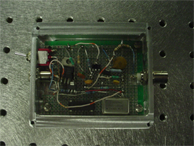
ABEL trap Circuit Analysis and Upgrades *Dean's Award for Undergraduate Research 2014 New research projects at the lab require not only the use, but also improvements of the ABEL trap, which works by alternatingly sending two laser beams through optical waveguides into the chip to excite a fluorescent particle in a fluidic channel. Based on the relative magnitude of the fluorescence, an electronic feedback signal is applied across the channel to compensate for any particle movement away from the trapping point. At its heart, this apparatus was controlled by an electronic circuit that needed to be repaired and improved upon. Felipe performed a thorough analysis of its components and functions, rebuilt circuits and installed updated components. In addition, he worked in the physical layout to facilitate future repairs and improvements, as well as addressing some wiring neatness that could be compromised by daily use. The circuit was then tested until it was fully functional and incorporated with the optical detection setup. The complete trapping system is now ready for new use in conjunction with an integrated nanopore to select, trap and study single biological molecules such as viruses and ribosomes on an optofluidic chip. |
|
Portable Pathogen Detection on Mobile Devices *Dean's Award for Undergraduate Research 2011 There is an increasing interest in molecular diagnostics that can be used at the point-of-care for quick, low-cost, and highly sensitive disease detection. A suitable platform needs to possess both novel hardware (sensing chip) and software (result reporting) components. Kavit addressed the software aspects to remotely view or control the results of a virus diagnostics test on mobile devices. Two mobile applications were created for the Google Android and Apple iOS platforms, which brought real-time feedback and streaming data of particle florescence from the optofludic chip. This project involved programming iPhone and Android applications, creating a LabVIEW server and testing the software with the virus detection platform. |
|
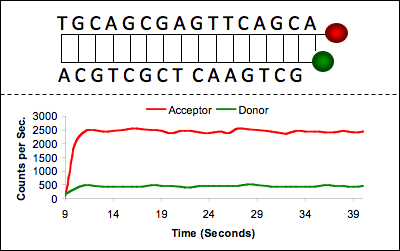
Design and Optimization of Fluorophore-Tagged Oligonucleotides for FRET Detection in Optofluidic ARROW Waveguides *Dean's and Chancellor's Awards for Undergraduate Research 2010 Fluorescence Resonance Energy Transfer (FRET) is a well-established method in biochemistry and biophysics to measure nanometer-scale distances by monitoring the relative emission intensity of two fluorescent dyes. FRET is a very attractive technique for implementation in integrated optofluidic devices. Melissa helped design and optimize a biomolecule with an efficient FRET output that is compatible with ARROW waveguides. By developing a protocol to remove single stranded DNA segments from a heterogeneous mixture, Melissa was able to increase the detected FRET efficiency from 60% to 91%. This project involved designing oligonucleotides, developing a biochemistry protocol for DNA separation, and optical testing of labeled oligonucleotides in an integrated waveguide setup. |
|
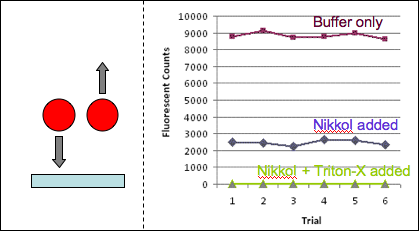
Biomolecule adhesion in Optofluidic Waveguides *Deans Award for Undergraduate Research 2010 Particle analysis in microfluidic and optofluidic devices typically involves moving and containing biomolecules of varying size and chemical nature in micronscale channels. Interactions of these molecules with the channel walls can significantly influence the device performance and are poorly understood in silicon nitride channels of small dimensions as in our liquid-core ARROW waveguides. Samantha carried out detailed studies of particle adhesion on silicon nitride surfaces, including a wide range of molecules (liposomes, ribosomes, viruses) and chemical conditions. This project involved preparing adequate mixtures of biomolecules in well-defined chemical conditions and studying adhesion using fluorescence spectrometry. |
|
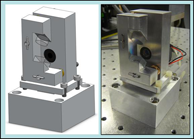
Extended Cavity Diode Laser for Atomic Spectroscopy *Deans Award for Undergraduate Research 2009 Lasers with narrow bandwiths are essential tools in atomic spectroscopy and the study of quantum interference effects in rubidium in particular. A popular approach is the extended cavity diode laser (ECDL) in which a grating is added to a laser diode to form the lasing cavity and determine the emission wavelength. Trevor redesigned an existing ECDL to substantially shrink its footprint and improve its properties. This project involved mechanical design of the laser housing, machining all parts, assembling the laser and optical testing of the laser operation. |
|
Pulse Generator for Single Photon Counting *Deans Award for Undergraduate Research 2008 The time-dependent emission intensity of a fluorescent effect can be studied by measuring and compiling the time difference between a photon emission with a low probability of detection and an electric pulse over many regular excitations. In order to compute and compile the time differences the TimeHarp 200 PCI card is used. The TimeHarp 200 needs an external pulse to perform the computations. Kevin designed and built the electric pulse generator required to provide the synchronization pulses from bipolar junction transistor technology. This project consisted of designing and laying out the design in computer software, assembling the circuit on circuit board, as well as machining a metallic housing for the circuit. |
|
Near-field Polarization Characterization *Dean's and Chancellor's Awards for Undergraduate Research, Huffman Prize 2007 The highest optical resolution can be achieved with near-field detection where a small aperture is brought very close to the surface of interest to detect any light emanating from the sample. In order to use this prinicple for characterization of magnets, the effect of the near-field aperture on the polarizaton of the light needs to be known. In his senior design project, Wil characterized the polarization properties of a new type of microfabricated near-field tips. He was able to show that the polarization properties depend strongly on the tip that is used. In addition, he had to machine several components to replace standard parts in the near-field microscope. |
|
Waveguide Loss Measurements The loss of power as light travels along a waveguide can be measured in different ways, some of which destroy the waveguide in the process. A non-invasive way of measuring waveguide loss is to detect the amount of light scattered from the top of the waveguide as a function of position. Alex used a high-resolution optical microscope with a CCD array detector to record the scattered light across ARROW waveguides and extract the waveguide loss coefficients from the data. This project included building a setup to investigate the waveguides under the microscope, taking and analyzing the data, and writing Matlab code to help with the data analysis. |
|
Differential Photodetector for Magneto-Optics (Dean's Award for Undergraduate Research 2006) Magneto-optical measurements use changes in polarization to determine the magnetic state of a material. If the material is a tiny nanomagnet, these measurements become very challenging and detection sensitivity needs to be optimized. A good way for sensitive magneto-optical detection is to split light into two polarization components and send it to two photodetectors whose signals are subtracted. Wesley built such a differential photodetector including the physical design, circuit design, testing and trouble shooting. |
|
Rubidium Spectroscopy Setup (Dean's Award for Undergraduate Research 2005) The goal of this project was to build a setup to measure the hyperfine structure of the absorption spectrum of rubidium vapor. The project including setting up optical elements, dealing with tunable lasers, and analyzing light transmission through atomic vapor cells as a function of wavelength. Palmer's work which also comprised his senior thesis was the basis for our future demonstration of the first integrated optical atomic spectroscopy cell on a chip. |
|
Far-field Waveguide Mode Measurement Setup (Dean's and Chancellors' Awards for Undergraduate Research 2004) The spatial distribution of power in the output of an integrated optical waveguide can be measured in different ways. Near-field measurements right at the facet provide a direct image of the mode, but are experimentally complex. A far-field image taken at a distance away from the waveguide is easier to carry out and yields the Fourier transform of the mode shape which can then be traced back to the actual image. This project entailed building a far-field detection setup, in which a photodetector is scanned in a two-dimensional plane to record the spatial image of the waveguide output. This work included building and calibrating the scanning setup, writing LabView code for computer control, and testing the instrument by recording and analyzing the output mode of different waveguides. This was also Senait's senior design project. |
|
Intersubband Spectroscopy of Quantum Dots (Dean's and Chancellors' Awards for Undergraduate Research 2004) The goal of this project was to adapt software for electronic band structure calculation for the C programming language and use the code to analyze optical intersubband transitions in semiconductor quantum dots. In addition, Philip carried out infrared absorption measurements on CdTe quantum dots in a Fourier Transform Infrared Spectrometer. This work involved modifying the sample space of the FTIR, working with semiconductor quantum dots, and analyzing the resulting spectra. His work was the basis of his senior thesis and also lead to a conference presentation in Switzerland which he co-authored. |
|
Optical Autocorrelator (Dean's Award for Undergraduate Research 2003) An optical autocorrelator is an apparatus that allows to measure the duration of short optical pulses from a femtosecond laser. This project consisted of building an autocorrelator from scratch, careful alignment of all parts and testing the instrument using pulses from a femtosecond laser. In addition, Steve wrote a LabView program for automated pulse characterization. This work was the subject of his undergraduate thesis. |
|
Magneto-Optic Kerr Effect Setup (Dean's Award for Undergraduate Research 2003) This project entailed building a simple magneto-optic setup that detects the polarization change of light as it is reflected from a magnetic surface. Tasks included setting up and aligning the optical elements, writing LabView code for automatic control, and testing the setup with various magnetic materials. The setup formed the basis for later experiments on single nanomagnet switching and was also developed into a lab experiment for our undergraduate class EE145 (properties of materials). |




 |