 |
 |
 |
 |
 |
 |
 |
 |
 |
 |

|


 |
Home / / / / / / Electrical Engineering Baskin School of Engineering UC Santa Cruz
© 2010 H. Schmidt. All rights reserved. Contact
 |
|
Atom Photonics and Slow Light on a Chip We are pioneering the development of atom photonics – self-contained chip-scale devices for integrated atomic spectroscopy and the observation and utilization of quantum interference effects in atomic vapors on a chip [1].
|
|
Integration of atomic vapors with semiconductor chips has many advantages (creation of compact atomic spectroscopy devices, large intensities over long distances, creation of complex optical layouts, potential for novel photonic devices, integration with other photonic elements on the same chip) and applications (frequency standards, slow and stopped light devices, metrology).
|
|
 |
|
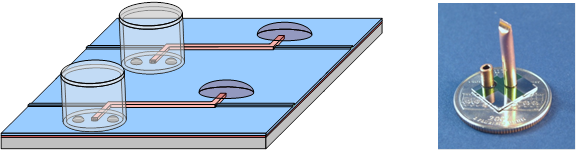
Fig. 1: Conceptual view of atomic vapor cell on a chip. Hollow-core (orange) and solid-core (blue) ARROW waveguides are combined on a silicon chip to create compact spectroscopy cells of mm length. Right: photograph of completed device. We are pursuing a number of open questions and research directions in this field:
Some of our recent accomplishments include:
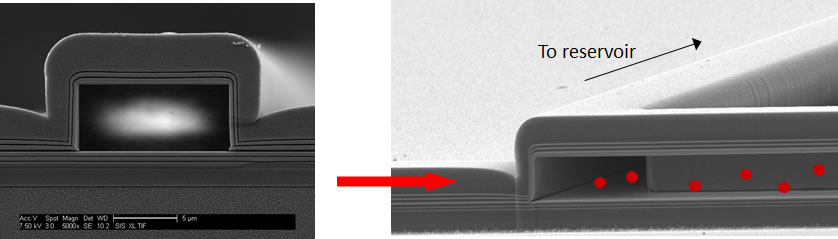
Here are some examples of our work on atom photonics: Integrated atomic spectroscopy cells In collaboration with the Hawkins group at BYU, we have developed hollow-core optical waveguides that form the ideal basis for atom photonic chips. Fig. 2 shows cross-section and side-view SEM images of these micron-scale channels that confine light using the thin film dielectric layers [1,2]. The thick top oxide of the hollow core channel simultaneously acts as the core for a solid ridge waveguide that allows for coupling light into and out of the hollow channel. This way, the channel can be routed to a different spot on the chip where a reservoir containing an alkali metal such as Rb is placed (see right image). Separate optical and atomic access to the waveguide channel greatly simplifies the chip design. In addition, the Hawkins group has optimized the approaches to sealing the reservoirs onto the chip without reacting with the alkali vapor. Heating of the chip then produces an optical vapor inside the hollow-core waveguide for carrying out spectroscopy. |
|
 |
|
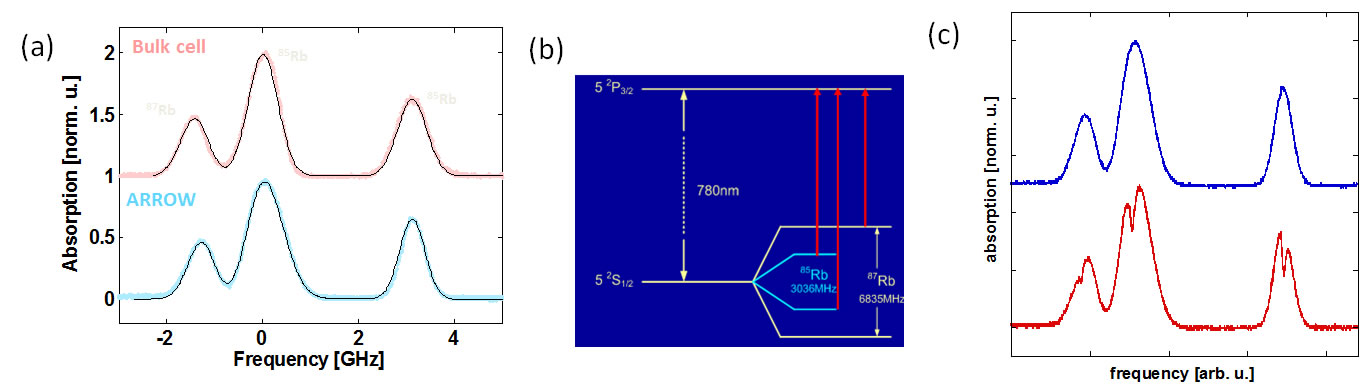
Fig. 2: SEM images of hollow-core ARROW waveguides. Fig. 3 shows the results of atomic spectroscopy on the hyperfine transitions of Rb (Fig. 3b). These can be used for applications in atomic clocks as well as to implement quantum coherence effects (see below). Fig. 3a shows how the linear absorption spectrum compares nicely with that observed in a glass bulk cell while Fig. 3c shows a saturated absorption spectrum where a counterpropagating beam depletes the atomic ground states and leads to characteristic Lamb dips in the spectrum that can be used for frequency calibration and stabilization. The waveguide geometry is ideal for this purpose since counterpropagating beams are automatically aligned via the waveguide modes.
Fig. 3: Atomic spectroscopy on a chip [6]. (a) linear absorption in waveguide chip and glass bulk cell; (b) corresponding Rb hyperfine spectrum; (c) SAS spectrum exhibiting Lamb dips in presence of counterpropagating beam. Slow light on a chip
Atomic cooling with AC Stark shift
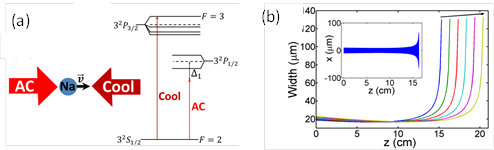
It is well known that the motion of atoms can be affected by light via radiation pressure and dipole (gradient) forces. This has enabled slowing and stopping of atoms. This effective cooling has formed the basis of magneto-optical trapping and Bose-Einstein condensation. One can cool an atom with a counterpropagating optical beam as the photons are absorbed and isotropically re-emitted. This redistribution of momentum results in a slowing force and effective cooling along the beam propagation direction. To be effective, the laser beam has to be resonant with the atomic transition in the reference frame of the atom. In order to compensate for the continually changing Doppler effect, the atomic resonance or the laser frequency has to be adjusted as a function of space. The former is typically done by using an inhomogeneous magnetic field via the Zeeman effect. We proposed an alternative method for keeping atoms and cooling beams in resonance that is ideal for implementation in (lossy) on-chip waveguides [7]. Fig. 5a shows the principle, in which a second light beam creates a spatially dependent AC Stark shift of the lower atomic level used by the cooling beam. If the power of the AC Stark beam is tailored correctly, the atom will experience a level shift that just compensates for the change in Doppler shift (both Doppler and AC Stark shift get smaller as the atom propagates). This AC Stark power can be matched with the waveguide loss in a hollow-core waveguide, for example by changing the width of the waveguide along the beam direction (Fig.5b).
This work is funded by DARPA/AFOSR under the Slow Light Program, and the National Science Foundation (NSF).
|

 |